

CODE Book Review
Your bi-monthly CODE appointment is back

Your bi-monthly CODE appointment is back.
This time, we bring you Antonio’s review of the book “The Shock of the Old: Technology and Global History since 1900” by David Edgerton.
Where Old Meets New: Technology, Power, and the Lessons of History
By Antonio Calcara
I’m writing a book on cloud computing and AI, surrounded—as one inevitably is—by hype about disruption, transformation, and technological destiny. That was precisely the moment when I felt the need to step back and read a book that could be an antidote to excessive hype about new technologies and, at the same time, that would help me to put things in a long-term perspective. The Shock of the Old by historian David Edgerton is a good book for that.
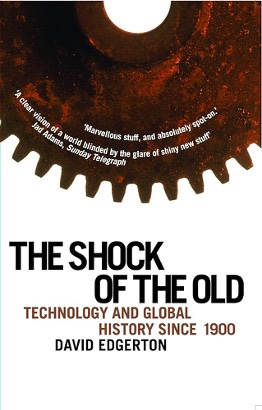
The AI debate is dominated by hype around cutting-edge innovations, breakthroughs, and so-called “game-changing” applications, often framed as deterministic drivers of economic and strategic power. Yet, I suspected that such an innovation-centric lens might obscure the more practical and consequential questions: how will AI actually be used, by whom, and in what contexts? Edgerton’s historical approach—focusing not on invention, but on use, adaptation, and diffusion—promises a corrective to the techno-optimism that saturates contemporary discussions, providing a richer framework for thinking about AI’s real-world effects. What follows is not a review strictu sensu, but just some disparate thoughts about the usefulness of the book for those of you who, like me, are interested in the intersection between technology, security and strategic studies.
The Thesis of the Book
Edgerton’s central argument is that the history of technology should not focus solely on innovations and inventions, as popular accounts often do, but on how technologies are actually used. He emphasizes that the historical significance of technology lies not in its novelty, but in its persistence, practical application, and the ways societies adapt existing tools to meet real needs. By focusing on use, diffusion, and the interaction of old and new technologies, Edgerton challenges linear, innovation-centric narratives and highlights the contingent, context-dependent nature of technological impact.
The book is not always an easy read and could have benefited from more clarity on methodological choices—for example, why Edgerton decides to include certain information and omit other material. Often, The Shock of the Old reads more like a thematic collection of examples than a tightly argued historical analysis. Chapters jump between disparate topics, without always providing clear analytical through-lines.
Yet the book’s value lies in the perspective it offers. A bit more on that below.
Three Reasons the Book Is “Refreshing”
1. Decentralizing the Perspective on Innovation
Edgerton invites readers to shift attention from the idea that technological history is driven solely by the West and by the “brightest” innovations. Instead, he emphasizes the importance of everyday, persistent technologies that continue to shape lives and productive systems globally. His attention to “creole technologies” - tools and practices locally combined in innovative ways - is particularly useful for understanding complex global phenomena where old and new coexist and interact, often challenging the linear narrative of modernization. This approach also highlights the cultural context: not all Western innovations are adopted, and their effectiveness often depends on a society’s ability to integrate and adapt them.
Also, the book decentralizes from the views of the producers of innovation themselves. Too often, as Edgerton notes in the introduction, “the agenda for discussing the past, present and future of technology is set by the promoters of new technologies.” This seems particularly relevant to the current discussion on AI, which is in fact primarily driven by those who are building AI technologies themselves, and who may therefore have a very informed view on the one hand, but on the other hand also a particularly biased one.
2. Correcting the Hype Around Military Technologies
I found the chapters on military technology especially illuminating, particularly as they highlight aspects I had not previously considered, such as the widespread use of horses during World War II. Edgerton cautions against overestimating the role of new technologies, such as the 1930s hype around bombers as “silver bullets” capable of deciding wars.
This perspective serves as a corrective to technological determinism in war — the idea that military outcomes are dictated solely by advanced technology — a point also recently emphasized by Anthony King in AI, Automation, and War. Military capacity depends not just on possessing advanced technologies, but on knowing how to use them, combining them with existing tools, and adapting to adversarial innovation. As I have observed (along with my brilliant co-authors) in works on military drones, warfare is best understood as a continuous process of innovation and counter-innovation. A technology’s value only emerges when contextualized within the interaction between old and new systems, and between resources, strategy, and human operators.
The ongoing Russo-Ukraine war provides a contemporary example: it demonstrates how old and new technologies — from drones and cyber tools to artillery and armored vehicles — are continuously recombined, adapted, and repurposed by users on the ground. This conflict underscores Edgerton’s insight about the role of users as innovators: soldiers and operators often create practical, effective innovations that escape official narratives of invention.
3. The Importance of Diffusion
Finally, Edgerton reminds us to resist innovation-centrism and adopt a more attentive view of technology diffusion, the process by which technologies are adopted, integrated, and embedded in economic, social, and military systems. This aligns closely with recent debates in International Relations scholarship, sparked by Jeffrey Ding’s Technology and the Rise of Great Powers, which emphasizes that the ability of states to diffuse general-purpose technologies across their economies drives long-term shifts in power more than the initial moment of invention.
Yet while both Edgerton and Ding challenge innovation-centrism, it is also important to recognize that innovation itself retains strategic significance, particularly in the short term. Early mastery of a breakthrough can create temporary advantages — shaping standards, operational practices, or battlefield outcomes before diffusion is complete. Scholars of military technological revolutions, have highlighted how early nuclear or precision weapon capabilities reshaped strategic balances precisely because they were adopted first, creating path dependencies and “lock-in” effects. Similarly, economic theory on first-mover advantage demonstrates that early innovation can secure enduring competitive positions even before widespread adoption occurs.
Edgerton’s framework complements this perspective by reminding us that the true impact of technology emerges not merely from invention, but from effective use and integration. Innovation sparks possibility; diffusion realizes impact. Understanding technological power thus requires attention to both dimensions: the short-term advantages of pioneering innovation and the long-term consolidation achieved through diffusion and adaptation. Only by holding both in view can we move beyond hype and assess who is likely to gain real strategic leverage from emerging technologies.
Conclusive Thought
The Shock of the Old is not an easy or immediate read, but it is stimulating for anyone who wants to understand technology in historical terms. For those of us interested in the future of AI and critical technology, Edgerton provides a valuable analytical framework: the success of technology is not just about novelty, but about intelligent use, recombination of old and new, and the ability to diffuse innovations effectively. In an era when enthusiasm for new technology often overshadows practical and strategic realities, The Shock of the Old is an essential reminder of the value of concreteness, critical analysis, and historical patience.
Brilliant framing of the use vs innovation debate. The bit about creole technologies really clicked forme - I've seen this firsthand in emerging markets where "outdated" systems get repurposed in ways Silicon Valley never anticipated. The diffusion angle matters way more than first-mover advantage in most real-world scenarios, especially for AI deployment.