

February Newsletter

Happy Lunar New Year, everyone!
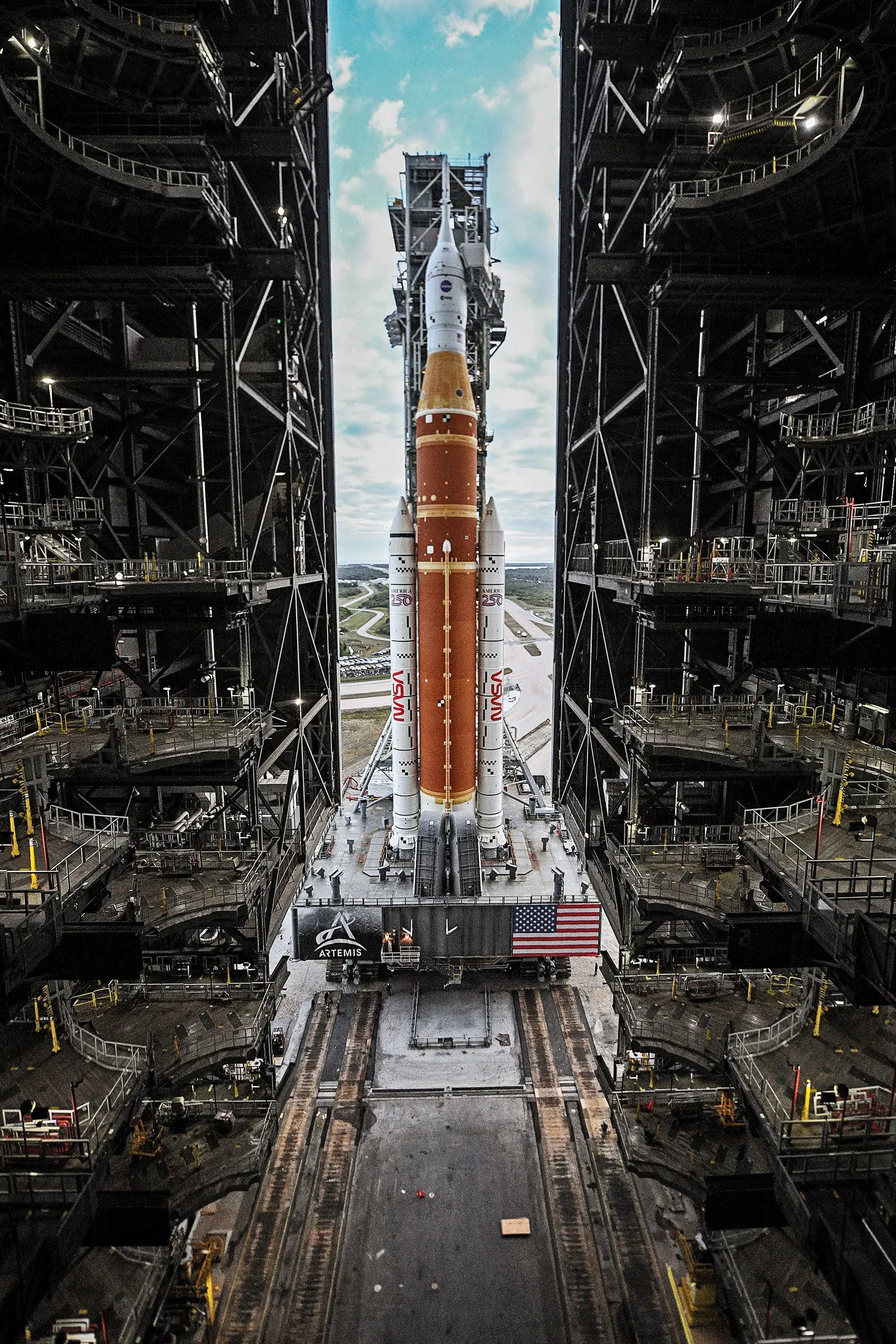
I’m Thao, covering space issues at CODE, and this month I would like to return to the Artemis programme as it moves towards what could become a defining moment in modern spaceflight: Artemis II. For many, it carries symbolic weight reminiscent of the Apollo years. After a year of budget turbulence in Washington and a series of technical setbacks, the mission is now targeting an early March launch window.
In essence, Artemis is a NASA-led, multiphase and multinational lunar programme with the Artemis Accords as a set of principles governing cooperation and operations among participating states. They are currently in Phase 2 which will undertake a 10-day crewed lunar flyby, sending astronauts farther into space than any humans have travelled before.
Source: TIME
Artemis II won’t land on the Moon, but its significance is hard to overstate. The flight aims to validate the Orion spacecraft and its systems in deep space while rehearsing the operational choreography between astronauts, launch teams, and mission control. In doing so, it will end a 54-year pause in human missions beyond low Earth orbit and pave the way for Artemis III which intends to bring astronauts back to the lunar surface in 2028.
But this is not Apollo 2.0.
The Cold War space race prioritised speed and national prestige. Massive budgets (with US space spending peaking at 4,4% of the federal budget, compared to around 0.5% today) and compressed timelines delivered historic results, at equally significant human risk.
Artemis reflects a different mindset. Safety standards are higher. International partnerships, diversity, and inclusivity are embedded in the architecture, albeit overtly hierarchical and political at times. For example, from a legal perspective, many posit that the Artemis Accords capitalise on ambiguities in the Outer Space Treaty to advance an American interpretation of space resource rights (see the Artemis series by Steer 2024; ud Din 2022). Drafted unilaterally by the US and later presented to selected partner states, participation in Artemis was effectively conditioned on adherence to US-favoured norms, thereby eroding multilateralism and the role of the United Nations in space governance.
However, compared to the old race, the Artemis still spans a much longer time horizon, involving a complex sequence of activities, infrastructure projects with a broader range of actors and commercial engagement. All this makes it a long-haul marathon to establish a sustained human presence on the Moon rather than a sprint on who arrives there first.
Where does Europe fit into this picture, as a close US ally and arguably the most significant Artemis partner?
Visibility towards ESA in this programme amounts to little more than a logo near the top of the rocket. Despite the language of international cooperation, the public narrative remains unmistakably US-dominated.
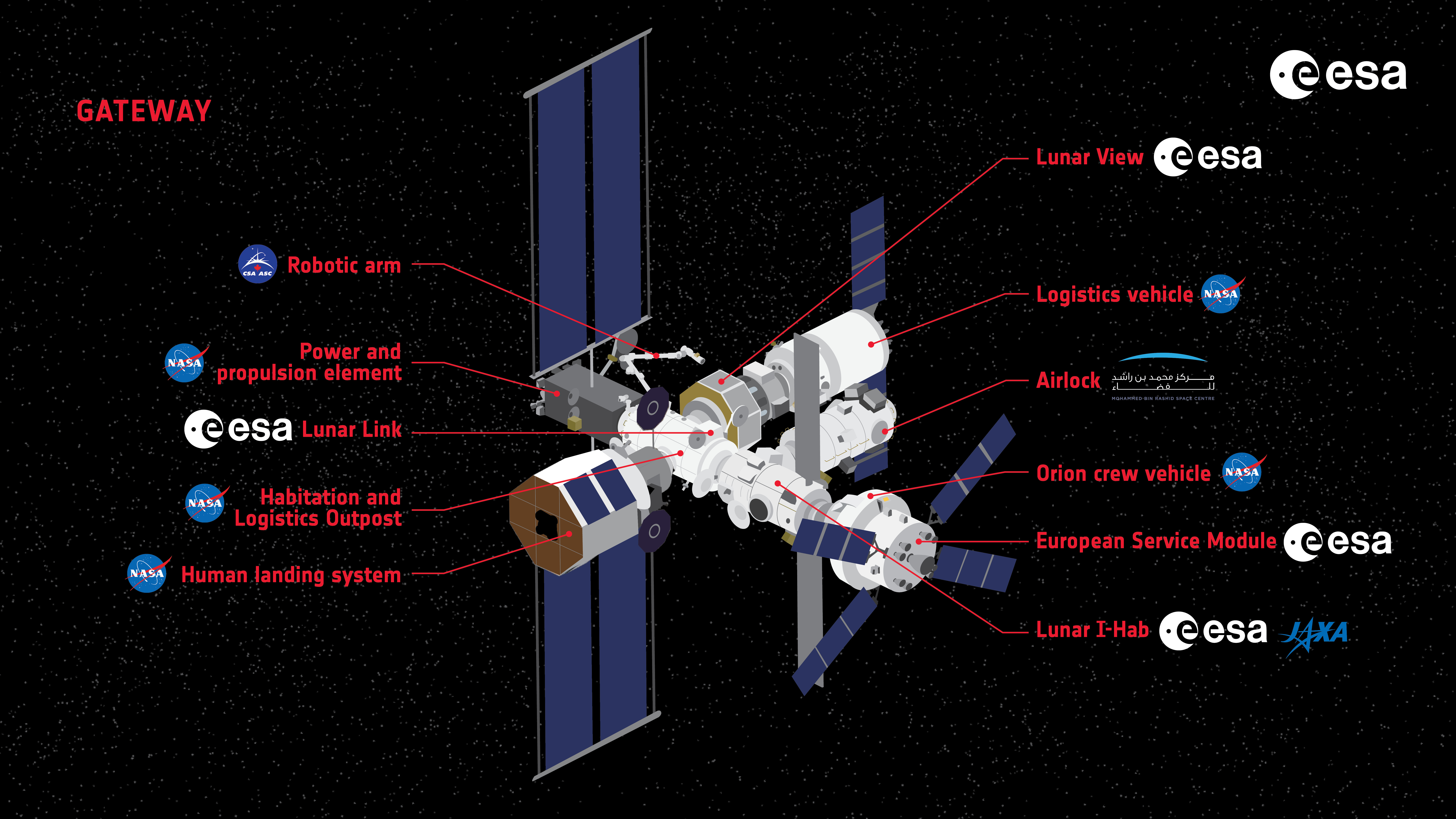
Yet Artemis quite heavily relies on Europe as well. The European Service Module, built by ESA and its member states, keeps the Orion spacecraft alive with propulsion, electricity, air, water, and more. As ESA’s Director General put it, “Quite simply, Orion could not fly without Europe.” ESA will also provide key elements for the Lunar Gateway, a modular space station in lunar orbit, including a refuelling/communications module and an international habitation module.
Source: ESA
As Europe steps into a larger role in the later phases of Artemis, there is a clear lesson. Technical contributions do not always translate into recognition and influence. European institutions need to articulate their role and craft their branding more assertively without allowing it to be subsumed under a MAGA, domestic framing of the programme. As major contributors to many NASA-led missions, ESA and member states should communicate their achievements more confidently, both at home and abroad, while catching up technologically to increase their leverage and negotiating power within the transatlantic partnership.
The race to the Moon has, of course, been ongoing for some time, intensified by China’s successful activities in recent years. Some analysts even argue that China could be the first to place taikonauts on the south lunar pole. This prospect adds time pressure for NASA and the US. Trump has since announced lunar missions as a priority to achieve a US landing before the end of his term in 2029. At the same time, Elon Musk has signalled a shift in SpaceX’s ambition from Mars back towards the Moon, further concentrating industrial and financial momentum around cislunar space.
Musk was openly dismissive of the Moon for years. Now, he speaks of building a “self-growing city”, whatever that is supposed to mean, within 10 years. In explaining the pivot, Musk points to resilience and speed. If Earth faces catastrophe, the Moon is more accessible than Mars with more frequent launch windows, shorter travel time, and a faster learning/development cycle.
But none of that is new? The physics haven’t changed in the last 20 years.
So, the underlying calculus might be purely financial. Funding, contracts, and political hype are increasingly concentrated around the Moon. There is also strategic alignment with his broader ventures in space-based AI infrastructure like orbital data centres. A lunar settlement could, in time, support manufacturing and energy capabilities relevant to those goals. There are also rumours that SpaceX will go public this summer. In that context, a near-term lunar roadmap offers a far stronger PR stunt than a distant promise of a Martian city.
All in all, geopolitical pressure, capital flows and commercial incentives are converging. The next few years are likely to bring a more accelerated lunar agenda with better performance and less tolerance for delays.
If you want an entertaining way to think through where this renewed space race could lead, science fiction often does the heavy lifting better than policy papers. I can’t recommend “For All Mankind” enough. I’ve watched it five times, and it’s still my all-time favourite (yes, I’ll even say it: better than Interstellar!). Starting as an alternate history in which the Soviet Union beats the US to the Moon, it explores what extended lunar competition might look like while unpacking the political, economic, and security consequences of building a permanent base beyond Earth.
Closely linked, here are two articles I genuinely enjoyed reading.
“U.S. Space Power and Alliance Dynamics in the Cold War” by Aaron Bateman revisits a historical case and shows that US space leadership relied heavily on allies and on access to foreign infrastructure. The article reinforces a point made in this newsletter: major space achievements rarely stand alone. They are enabled by networks of cooperation and allied contributions deserve more emphasis in the current rhetoric.
“Empire of the stars—not yet? China as a ‘partial’ great power in space” by Dimitrios Stroikos shifts the lens to the present. Stroikos critically evaluates China’s status as a major space power, arguing that while Beijing has accumulated substantial material and technological capabilities, it has not yet been able to translate them into comparable influence in diplomacy and governance. For that reason, he suggests that China does not yet stand on equal footing with the US in overall space power.
Lastly, if you’re interested in understanding the broader context in which all of these space events are unfolding, give “The Triangle of Power: Rebalancing the New World Order” by Alexander Stubb a try. His idea of “value-based realism,” articulated at Davos, was quite intriguing, combining hard-nosed strategic thinking with a commitment to liberal values. Applied to space, it means acknowledging space as strategic where cooperation is increasingly grounded in security-first logic. At the same time, liberal democratic values shared among allies and like-minded partners should be considered a strong asset rather than a weakness, fostering trust and effective collaboration while also offering a more compelling alternative to more closed and authoritarian models of space governance.
Enjoy reading and till next time!