

June Newsletter

Things are moving fast.
Several major events occurred in the space sector in the last few months. Artemis II launched, flew around the Moon and came home. The Artemis III crew has just been announced. And SpaceX—the company that has done more to reshape the geopolitics of space than many other state actors—went public. If this domain used to feel like background noise in international affairs, it no longer does.
Circling back on Artemis II
On April 1, four astronauts strapped into an Orion capsule (partly EU-made!) and flew around the Moon. During their ten days in space, the toilet clogged and Outlook Mail refused to open. But thankfully, it is still a success story and the mission was able to test and gather a great deal of data. With better equipment than in the Apollo era, scientists can now learn more about how deep space affects the human body, from radiation levels that exceed previous predictions to molecular-level insights from tissue experiments the crew carried with them.
The flyby also produced the most detailed observations of the Moon’s far side ever captured by human eyes, including ancient impact craters and geological features. And some of the most valuable images were not of the Moon at all. They are Earth photographed from a quarter million miles away, giving lay people like us the same quiet reminder that every astronaut comes back with: our planet is small, fragile and very much alone out there.

Source: NASA
So, when the prominent scientist and environmentalist David Suzuki said in one of his interviews that “Artemis is a stunt,” claiming that we are just repeating what we did 60 years ago and all the money spent now is going to waste, I respectfully disagree. Not only do we learn new things and come back better prepared, but the trip also reignited that same “Apollo spirit.” Just look at how space is now being discussed regularly in daily news and mainstream channels.
Space popularisation matters for at least two reasons. First, space exploration and eventual settlement are inevitable next steps for humanity. Off-worlding industrial capabilities and pollution is one of the more credible paths to preserving Earth while maintaining (economic) growth. Public attention and support are necessary to steer political direction and accelerate that process. Second and more immediately, there is a space race and our current geopolitical adversary is running at full throttle. China is all in, not only with its heavy investment in rockets and satellites but also incultivating generations that want to work on/in space. Space science is part of the national curriculum for primary school students across the country. For example, the Tiangong Classroom—a programme in which taikonauts teach live science lessons from aboard China’s space station—has been running for many years and repeated with each new crew. Then there is a cultural dimension. China’s science-fiction industry reached around $17 billion USD in 2025, up 15.7% year on year with a 203.3% surge in related search traffic. If you have Netflix, you might also have seen The Three-Body Problem that has become very popular in the West. That is no small feat for a Chinese novel adaptation, which is often considered to be of lesser quality. Thus, Beijing really has a whole-of-government approach when it comes to space and advanced tech in general. If the West (here, I mean Europe to a greater extent) is serious about staying competitive, it has to at least match that effort.
Project Ignition
The United States is doing exactly that. Since March, NASA Administrator Jared Isaacman has announced a series of new developments for the Moon. The Lunar Gateway, a space station that was supposed to orbit the Moon and had been ESA’s main contribution to the Artemis programme, was scrapped. In its place: a $20 billion programme called Project Ignition to build a permanent base directly on the lunar surface by the mid-2030s. The approach is modular and phased, starting with achieving reliable, high-rate access to the Moon through rockets, drones and lunar terrain vehicles.Phase 2, from 2029 to 2032, will focus on building infrastructure such as power systems and surface communications. Phase 3, from 2032 onwards, will be about delivering permanent habitats and the start of full in-situ resource extraction. “The clock is running in this great-power competition,” Isaacman said, “and success or failure will be measured in months, not years.”
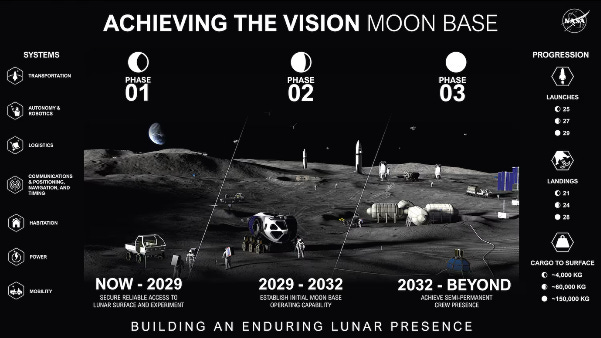
Source: NASA
Besides the fierce geopolitical rivalry, there is also domestic competition in the private sector from which NASA is buying services at an unprecedented scale. NASA has deliberately kept both SpaceX and Blue Origin (read: Musk vs Bezos) in the race for the Moon lander. In 2021, it awarded the human landing system contract exclusively to SpaceX with its Starship vehicle. Blue Origin sued, lost and spent the next several years building anyway. Now, under the revised Artemis architecture, both companies are back in the game, competing head-to-head for Artemis III in late 2027 which is an orbital test mission where astronauts (one Italian from ESA) aboard Orion will attempt to rendezvous and dock with each company’s lander variant in Earth orbit. Whichever is ready goes first. And the actual Moon landing is subsequently scheduled for 2028. Blue Origin has quietly been ahead with its Blue Moon Mark 1 lander having already passed the test and being ready to touch down at the lunar south pole this autumn. One complication, though, is that Blue Origin’s New Glenn rocket, which is what gets the lander to orbit, exploded last month during a routine ground test. NASA reiterated that they still expect both companies to be ready for the late 2027 mission, but whether that confidence survives the next 18 months remains to be seen.
This setback for Blue Origin only came to the advantage for SpaceX which went public in June 12. It raised approximately $75 billion at a valuation of $1.77 trillion—the largest IPO in history. Many sources have framed this as a watershed moment since SpaceX now sits at the intersection of commercial infrastructure, communications, artificial intelligence and national security. Yet its governance remains closer to that of a start-up than to that of a traditional conglomerate, with Musk retaining about 85% voting control of the company. Never before have tech oligarchs become a geopolitical variable that can have disproportionate consequences stemming from political controversies, regulatory disputes, profits or simple strategic miscalculations.
“Are we pilots or passengers?”
These new developments lack any serious discussion of what this means for US allies and partners. Certainly, I do not know how internal dialogue between transatlantic institutions are unfolding. However, judging from the public narrative, the marginalisation I previously highlighted has not diminished and European actors have clearly noticed. In his article “Are we pilots or passengers?,” the ESA Director put into words a painful reality: “Europe has become too exposed to decisions beyond its control.” Following this, he made the case for autonomous human spaceflight to secure EU freedom of access to space. I would love to see this happen as images of flags, astronauts and rockets are emotionally and politically powerful in ways that satellites simply cannot do. But the costs are sobering and the window to compete on those terms has likely already closed. Europe has previously given up major capabilities, such as the successful Automated Transfer Vehicle, in favour of other priorities. So, rather than chasing the most prestigious but also most expensive segment of the space economy, Europe may need to ask whether its strategic advantage lies elsewhere. I think there is already a strong case for building on European strengths in in-space operations and services, including manufacturing, debris removal, robotics and other adjacent technologies.
The structural problem that undermines every version of the EU debate is market fragmentation. SpaceX’s rise would not have happened without public intervention. Europe’s equivalent investment, on the other hand, has been spread across national programmes, each pursuing overlapping objectives and sustaining only parts of a supply chain. The result, as many experts have warned, is that Europe will fail to create a strong demand base necessary for its industry to justify the development of the required technology and infrastructure. There is also a resurgence of the EU branding problem. There is no European equivalent of NASA’s cultural footprint, no European SpaceX moment that lands in the public imagination. Most people who use Galileo daily think they are using GPS. Most people who watched astronauts fly around the Moon in April had no idea the engine powering that capsule was built in Bremen. Copernicus, the most precise Earth Observation system ever built, is essentially invisible to the public it serves.
Some initiatives are trying to change this. A recent Euractiv piece, for example, illustrated the symbolic power of flags as one of the simplest tools of identification available. Across the continent, social scientists, artists and storytellers are increasingly pushing this issue to the foreground, exploring what European identity in space might actually look and feel like. But institutions also need to take public uptake more seriously and step away from technocratic language that simply does not inspire. A citizenry that cannot name a single European space achievement is not a citizenry generating political will for investment and follow-through. The strategic and sovereign imperative is now clearly there, many have named it. But space is a very long game that needs public buy-in to survive elections, budget cycles and geopolitical ups and downs.
Before you go…
If the problem of EU market fragmentation and strategic autonomy sounds familiar, it’s because we’ve seen this movie before—in semiconductors, cloud computing, critical raw materials and other tech stacks. The lessons and actions learnt in these sectors will be most directly transferable to space.
On July 9, CSDS colleagues alongside the CHIPDIPLO consortium will discuss these issues in depth at the conference “Semiconductors Under Geopolitical Stress: From Global Shocks to the European Chips Act 2.0,” exploring the geopolitical future of semiconductors and EU policy options amid intensifying US-China competition.
If you’re in Brussels and this resonates, please find the programme details and register here.
Do not hesitate to connect with our CODE team during the event. Otherwise, till next time!